Forex lot size: how to size a trade from the stop loss
The formula for lot size from your stop and risk per trade, pip values for the main pairs, and ready tables for $1,000, $5,000 and $10,000 accounts.
On this page
Most traders pick a lot size first and then look at the stop. That gets it backwards. The stop loss is set by the market: it is where the trade idea stops making sense. The lot size is the only thing you control, so it should be worked out from the stop.
The formula
You need three numbers: how much of your balance you will lose if the stop is hit, how many pips away the stop is, and what one pip is worth for one lot of the pair.
Lot size = money at risk ÷ (stop distance in pips × pip value per lot)
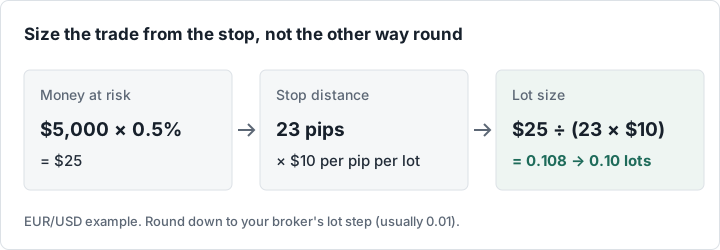
The example in the picture: 0.5% of $5,000 is $25. With a 23-pip stop on EUR/USD, where one lot is worth about $10 per pip, the size is $25 ÷ (23 × $10) = 0.108 lots. Brokers sell in steps of 0.01 lots, so you round down to 0.10. Rounding up would mean risking more than you decided.
Pip value per lot
One standard lot is 100,000 units of the first currency in the pair. What a pip is worth depends on the second currency, the one the price is quoted in.
| Pair | One pip is | Per standard lot | In US dollars |
|---|---|---|---|
| EUR/USD, GBP/USD, AUD/USD | 0.0001 USD | 10 USD | $10.00 |
| AUD/CAD, USD/CAD | 0.0001 CAD | 10 CAD | about $7.10 at USD/CAD 1.40 |
| USD/JPY, EUR/JPY | 0.01 JPY | 1,000 JPY | about $6.45 at USD/JPY 155 |
For pairs that are not quoted in your account currency, the dollar value moves with the exchange rate. Your trading platform shows the exact figure in the order window or the symbol specification; use that number in the formula.
Ready tables at 0.5% risk
These are for EUR/USD, GBP/USD and AUD/USD ($10 per pip per lot), already rounded down to 0.01 lots.
| Account | Money at risk | 20-pip stop | 30-pip stop | 40-pip stop |
|---|---|---|---|---|
| $1,000 | $5 | 0.02 lots | 0.01 lots | 0.01 lots |
| $5,000 | $25 | 0.12 lots | 0.08 lots | 0.06 lots |
| $10,000 | $50 | 0.25 lots | 0.16 lots | 0.12 lots |
Two things stand out. A wider stop means a smaller position, not a bigger loss. And on a $1,000 account the smallest lot (0.01) already risks $2 to $4 on these stops, so there is little room to adjust. If a stop is so wide that even 0.01 lots risks more than you planned, skip the trade.
For AUD/CAD, use the lower pip value: on a $5,000 account with a 30-pip stop, $25 ÷ (30 × $7.10) = 0.117, so 0.11 lots.
Mistakes that break the maths
- Using the same lot size for every trade. A 15-pip stop and a 45-pip stop with the same size are two very different risks.
- Forgetting the spread. A sell is closed at the ask price, so the stop is hit when the ask touches it. When spreads are wide, your real loss can be a pip or two more than the distance on the chart.
- Moving the stop after sizing. If you move the stop further away, the size you calculated is now too big for the risk you chose.
- Raising the size after losses to win it back. The formula does not change after a bad week; only the balance does.
Where to use it
Every ZForex signal shows the stop loss, and the signal page shows the stop distance in pips. Put that distance into the formula with your own balance and risk per trade before you place the order. Read more about the parts of a signal in how to read a forex signal.
Forex trading carries a high risk of loss. This article is general information, not financial advice.